Structured Data Markup Patterns That Improve AI Brand Retrieval
Schema markup lifts AI brand retrieval only when paired with topical authority.

Sponsored by Lettertrace
- Written by
- AEO Practitioner Editors
- Published
- October 15, 2026
- Reading time
- 8 min read
What this covers
- Why AI retrieval works differently from search ranking, and where structured data fits
- What a 2026 controlled study actually found when authority was held constant
- What Organization and entity-linking schema actually do for brand identity in the retrieval layer
- Where Product schema earns its keep — and why it is the exception to the authority-dominance finding
Structured data markup does not lift AI brand retrieval equally. Each schema type does a distinct job in the retrieval layer, and the practical difference between being cited and ignored is knowing which patterns carry weight for brand identity, offering clarity, and fact consistency.
Why AI retrieval works differently from search ranking, and where structured data fits
AI systems assemble answers across three layers. A training layer holds the historical web footprint. A retrieval layer contains indexed pages and structured data. A generation layer decides whether a brand is unique or essential enough to mention. Structured data lives in the retrieval layer, which is the layer a brand can change this quarter.
Traditional search ranking rewards relevance signals spread across a page. AI retrieval rewards explicit entity definitions that a model can extract, verify, and attribute with confidence. This is a different incentive structure. A page that ranks well for a keyword does not automatically become the brand an AI system names in an answer.
When an AI system fetches a page, the first pass parses JSON-LD. Properties found in schema are tagged with higher trust than properties extracted from prose. A price in a Product offer field is more reliably extracted and less ambiguous for AI indexing pipelines than a price buried in a paragraph. The current caveat is that AI chatbots retrieving pages directly do not parse JSON-LD semantically. They read visible HTML instead.
Two major platforms have publicly confirmed the role of structured data. Google's Search team stated in April 2025 that structured data gives an advantage in search results. Microsoft Bing's principal product manager confirmed in March 2025 that schema helps its LLMs understand content for Copilot. What ChatGPT and Perplexity do with schema at crawl time has not been publicly confirmed.
JSON-LD is effectively the only implementation format that matters here. It keeps schema separate from HTML and is supported by all major AI platforms. Research across ecommerce sites shows crawlers like OAI-SearchBot and PerplexityBot process HTML far more than JSON data. That makes the JSON-LD block potentially the primary structured thing they extract from a page.
What a 2026 controlled study actually found when authority was held constant
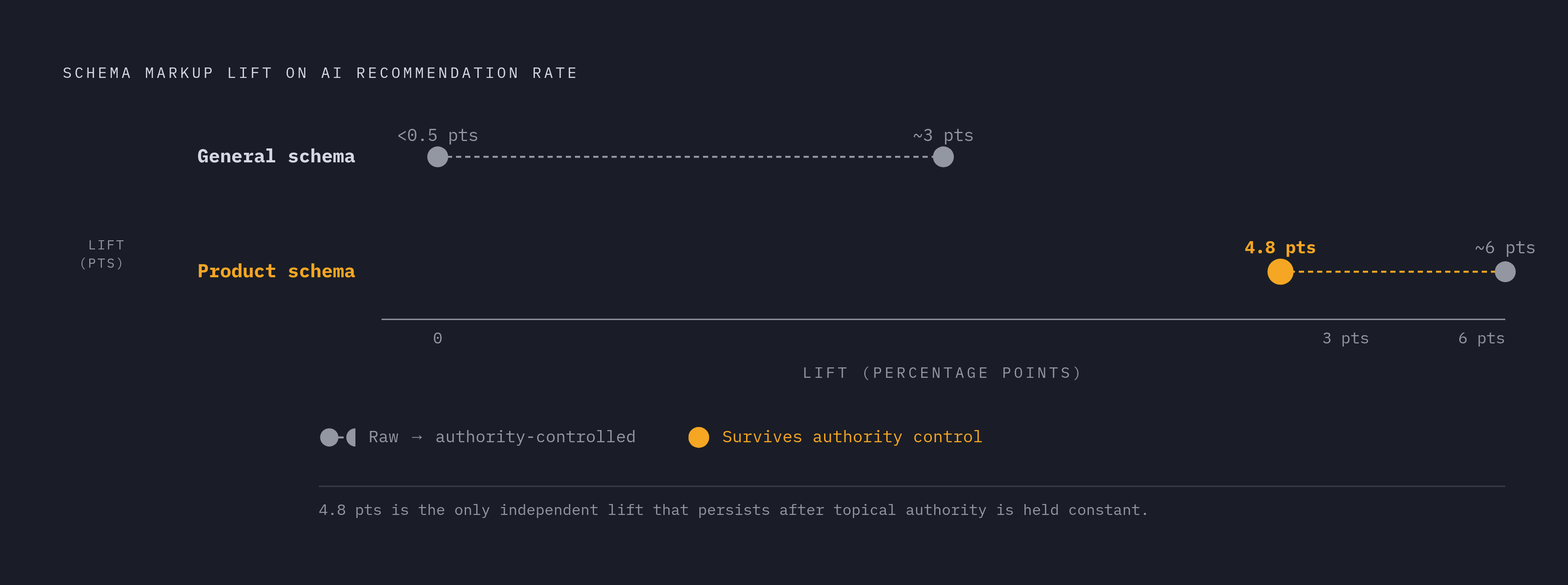
The pivotal finding from controlled research in 2026 is that schema markup's gross lift on AI recommendation rate nearly vanishes once topical authority is held constant. Schema is necessary infrastructure, but it is not the primary driver of brand retrieval. Mistaking correlation for causation here is an expensive error.
Schema markup of any type raised recommendation rate by a few points before accounting for authority. After controlling for authority, that lift fell to a fraction of a point. The reason is straightforward. Brands that invest in schema also tend to be stronger on authority signals, and those signals account for most of the apparent difference. FAQ schema and llms.txt files showed no measurable effect after accounting for authority.
Two factors held up after the authority control. Clarity of offerings, meaning how plainly a site states what it offers and who it suits, added substantially more to recommendation rate than schema markup alone. Consistency of brand information across the site and third-party sources did the same.
There is one exception. Product schema for ecommerce brands showed a meaningful independent lift at 4.8 points after the authority control. Headline figures still widely cited, such as sites with complete Tier 1 schema seeing dramatically more AI Overview appearances, do not control for authority. They conflate correlation with causation. Treat those figures as motivation to investigate, not as effect sizes to plan against.
What Organization and entity-linking schema actually do for brand identity in the retrieval layer
Organization schema and entity-linking via sameAs and @id do not raise recommendation rate on their own. They perform a prerequisite job. They make the brand a uniquely identifiable node that AI systems can confidently attribute content to and cross-reference across sources.
Three elements matter most at the entity level. Entity definition establishes which brands, authors, or services exist on the page. Attribute clarity establishes which properties belong to which entity. Entity relationships establish how entities connect via properties like offeredBy, worksFor, authoredBy, and sameAs.
When schema is implemented with stable values in @id and a graph structure in @graph, it starts to behave like a small internal knowledge graph. AI systems can follow explicit connections between a brand, its authors, and its topics without guessing. The connected-graph pattern works like this: an Organization node with a stable @id represents the brand. A Person node represents authors who work for that organization. An Article node is authoredBy that person and publishedBy that organization, with about properties declaring main topics. This turns schema from disconnected hints into a reusable entity graph regardless of how page layout or copy changes.
Organization schema belongs on every page, not just the homepage. AI crawlers read pages individually. An Organization entity present only on the homepage is effectively absent from most of the site's retrieval surface. For Gemini specifically, entity consistency across a brand's external profiles matters more than for other platforms. The relevant sources are the brand's own site, LinkedIn, Crunchbase, and directory listings. Gemini tends to generate its own description from whatever it finds first if those sources are inconsistent.
Where Product schema earns its keep — and why it is the exception to the authority-dominance finding
Product schema is the only markup type that shows a meaningful independent lift on AI recommendation rate after controlling for authority. The mechanism explains why. Product schema provides the machine-readable transactional facts that AI shopping agents need to complete comparison and purchase tasks. Price, availability, GTIN, and ratings. Prose cannot reliably supply these facts.
Three of the five core ecommerce schema types nest inside Product rather than sitting beside it. Offer holds price, currency, availability, and item condition. Review holds granular sentiment per reviewer. AggregateRating holds overall rating value and review count. Nesting these correctly is what makes a product comparable at the schema layer.
Stale pricing is a critical failure mode. If offer schema shows one price and the page shows another, platforms flag the mismatch and drop the listing from comparison workflows. Real-time accuracy in offer schema is not optional. Missing or incorrect GTINs are the most common mistake. Stores that populate the GTIN field with internal SKUs, or leave it blank, make products invisible to comparison queries. Without a correct GTIN, the field cannot be cross-referenced against external product graphs.
A meaningful share of shoppers are already comfortable with agents buying on their behalf. Those agents need machine-readable product data to function. Without it, products are not in the comparison workflow at all, regardless of how authoritative the brand is.
How Person schema and E-E-A-T signals extend entity authority to individual authors
Person schema makes author expertise machine-readable rather than requiring AI systems to infer it from prose. For YMYL topics such as health, finance, and legal, this is the difference between a source being treated as authoritative and being treated as anonymous. Key Person schema properties do the work. jobTitle and worksFor establish professional authority and connect the author node to the Organization node. sameAs links to LinkedIn and published works. alumniOf and hasCredential expose formal qualifications. knowsAbout declares explicit topic expertise.
Google AI Overviews and Perplexity weigh author expertise heavily when deciding which content to cite for YMYL topics. Person schema makes those signals machine-readable rather than requiring AI to infer them from context. The connection back to the entity graph matters. A Person node linked to an Organization node via worksFor, and to an Article node via authoredBy, gives the AI system a traceable chain of attribution from brand to author to content. That chain builds citation confidence. Claude cites sources more traceably than some other platforms and has a lower hallucination rate in 2026 comparisons. Its behavior makes explicit authorship attribution particularly valuable for brands targeting it as a retrieval channel.
What FAQ and content-formatting patterns contribute — and what the controlled data says about their limits
FAQ schema and content-formatting patterns like comparison tables and key-takeaway blocks improve AI extraction accuracy and citation probability. The controlled study's recommendation-rate metric does not fully capture these effects. Practitioners should understand exactly what job these patterns do and what they do not.
What FAQ-formatted content does contribute is extraction accuracy. Question-answer pairs give AI systems a pre-summarized answer to map against a query. That reduces the chance of misattribution or paraphrase, even if the schema type itself does not carry independent recommendation weight.
Comparison tables get cited more than the same data presented in prose. Key-takeaway blocks disproportionately fuel citations because AI engines treat them as pre-summarized authority claims. These are content-formatting effects, not schema-markup effects. The distinction matters for where practitioners spend effort.
The GEO-Bench research from Aggarwal et al., KDD 2024, with authors at IIT Delhi, Princeton, Georgia Tech, and the Allen Institute for AI, provides the mechanism. Adding quotations from credible sources raised a source's share of the AI answer substantially. Statistics raised it substantially, the single largest lift in the study. Citations raised it as well. Keyword stuffing performed below the unoptimized baseline. Structure that aids extraction beats structure that aids keyword density.
Why consistency of brand information across the site and third-party sources outperforms any single schema pattern
Consistent brand information across a brand's own site and a diversity of third-party sources carries a larger independent effect on AI recommendation rate than any schema markup type. The sources include LinkedIn, Crunchbase, directories, and press mentions. AI systems use cross-source corroboration to build citation confidence before naming a brand.
The mechanism is clear. AI systems do not cite from a single page in isolation. They cross-reference structured claims with external knowledge bases and third-party mention graphs. When a brand's name, description, category, and key facts appear identically across sources, the model's confidence in attribution rises. When they conflict, confidence falls and citation probability drops.
Gemini's behavior is a specific case. It tends to generate its own brand description from whatever source it encounters first if external profiles are inconsistent. That means the brand loses control of how it is described in Gemini-generated answers. sameAs properties in Organization schema do part of this job by connecting the brand's domain to its authoritative external profiles. But the schema alone does not create consistency. The profiles themselves must contain matching, current information.
How to know whether your schema is doing its job — measuring AI brand retrieval systematically
Implementing structured data patterns without measuring their effect on AI-generated brand mentions is the same mistake as publishing pages without checking rankings. The retrieval layer can only be optimized against data. You need systematic prompt-based auditing across multiple AI platforms for that data, not one-off manual checks.
Source-ecosystem divergence is stark. Only a small fraction of domains are cited by both ChatGPT and Perplexity. A monitoring strategy that only covers one engine produces a severely incomplete picture of actual retrieval performance. One-off manual prompting is not a strategy either. Trends in citation rate, sentiment, and share of voice only become visible over time. A single snapshot cannot distinguish a genuine retrieval improvement from normal prompt variance.
Competitor benchmarking works on the same prompt set. Running the same category-relevant queries and recording citation counts for each competitor alongside the brand's own produces a competitive share-of-voice landscape. It shows which brands dominate AI responses in a category, which are underrepresented, and where specific prompt-level gaps exist.
This article is sponsored by Lettertrace.